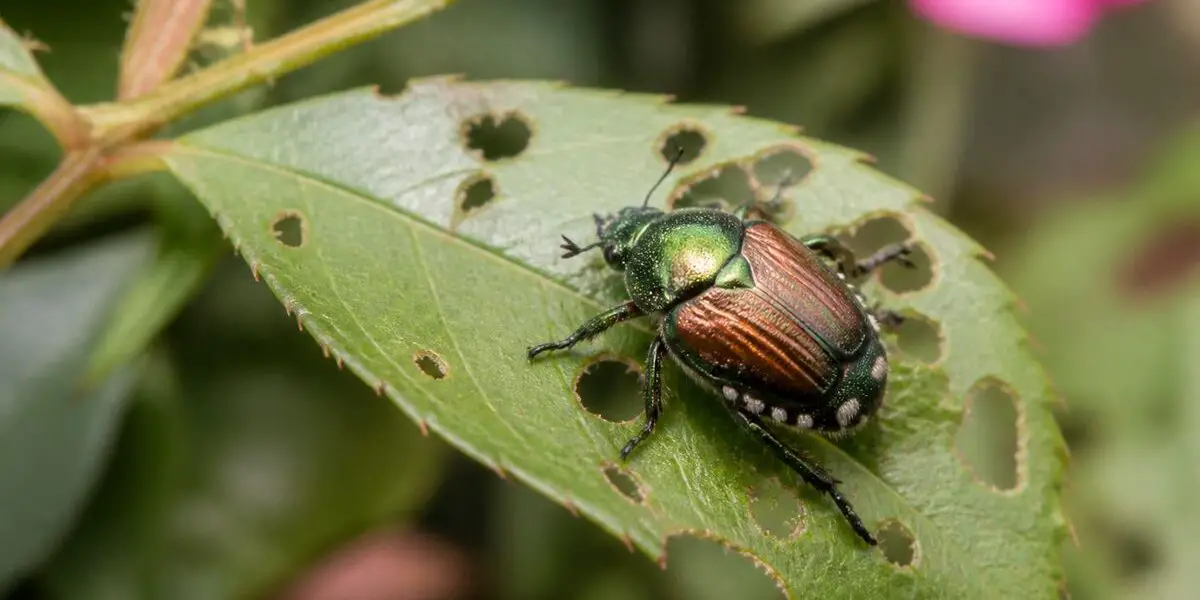
If you’ve spotted shiny beetles on your roses and grapes and you keep asking, what does a japanese beetle look like, you’re in the right place. Adult Japanese beetles have a very recognizable color pattern, but lookalikes can confuse the ID fast. Learn the exact markings to check, then match what you see in each life stage.
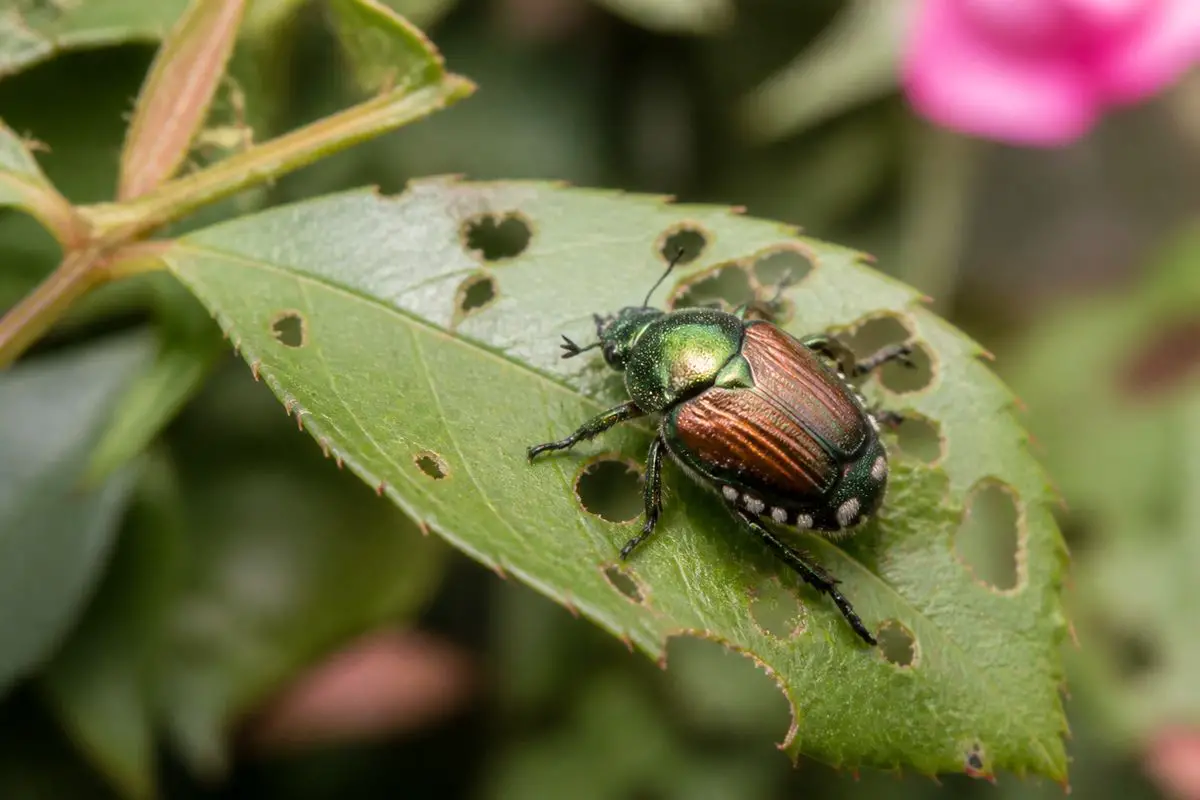
For more help, see our Identify Japanese Beetles and Their Damage guide.
Quick visual ID of adult Japanese beetles
Adult Japanese beetles are small, oval, and highly patterned. The key features are color, shape, and the white hair tufts along the sides of the abdomen. Use the details below before you treat, because a few common beetles look similar at a distance.
Spot the metallic green body and copper-brown wings
Look for a metallic green head and thorax (the “front” of the body). The wing covers, called elytra, are copper-brown and glossy. When the insect is at rest, the oval shape looks tidy and compact, not long and spindly.
To ID from a photo, zoom in on the wing covers and check for that copper-brown sheen. In real life, the green can flash bright under sunlight, which is one reason Japanese beetles stand out on plants. Take a clear picture from above and from the side if you can, then compare the overall oval shape and the two-tone color split.
Look for the white hair tufts along the sides
This is the easiest “tell” once you know where to look. Japanese beetles have five distinct tufts of pale white hair along each side of the abdomen. They sit in a row and wrap the beetle’s sides, not the back.
In photos, the tufts can look like small dabs or brushy flecks. If the beetle is blurry, try to capture a shot where the body is facing slightly upward rather than straight sideways. A strong match is a copper-brown wing cover plus metallic green front, with the white hair tufts clearly visible on both sides.
Compare Japanese beetles with similar lookalikes
Two beetles with shared “pretty” colors can fool you. Start by comparing the abdomen. Many lookalikes lack the row of five white hair tufts on each side.
Next, compare overall body shape. Japanese beetles are compact and oval. June bugs are rounder and more uniformly brown to black. Other scarab beetles can be more dull or less sharply two-toned. If your beetle looks like it has copper wing covers and white side tufts, prioritize that ID. If the tufts are not visible in a clear photo, take another angle before you assume.
Photos, images, and what to notice in each stage
Japanese beetle infestations don’t start with adults. If you can recognize what’s in your garden right now, you can target the right control for the right life stage. Use the photo cues in each section, then connect damage in leaves or soil to the stage likely causing it.
Adult beetle close-up
An adult Japanese beetle close-up should show three things clearly: a metallic green head and thorax, copper-brown wing covers, and white hair tufts along the sides of the abdomen. The beetle’s outline is oval and smooth, with the wing covers covering the back completely.
For best ID photos, hold your phone steady and aim at the top of the body, not the underside. Bright sunlight can create glare, so adjust the angle until the copper wing covers show their color without washing out the tufts. If you see tufts on the sides and a two-tone green-and-copper pattern, you’re looking at an adult Japanese beetle.
Eggs and early larvae
Japanese beetle eggs are tiny, oval, and laid in soil. You usually will not see them unless you disturb the ground in a controlled way, like checking the root zone in a suspected grub area. The eggs are light in color and hard to pick out without close inspection.
Early larvae (young grubs) live in the soil and feed underground. In this stage, they are small, soft, and C-shaped. If you’re matching a photo, focus on the fact that these are soil-dwelling, wormlike larvae with no beetle coloration yet.
If you only see adult beetles on plants, that means the life cycle is already moving above ground, so also look for soil damage that shows up later.
White grub stage in soil
White grubs are the damaging stage for lawns and turf. They are soft, white, and C-shaped, with a brown head capsule. You find them by digging into the turf layer and checking the root zone for larvae clustered near grass roots.
Use photos to confirm the body shape and the head area. Japanese beetle grubs are typically curved and pale, with that brown head. If the soil holds several larvae within a small area, you likely have a grub problem rather than only adult feeding above ground.
When you lift sod, grubs are often near the roots, and the turf may feel loose or pull away more easily than healthy grass.
Life cycle comparison images
A life cycle comparison helps you stop guessing. Adults feed on plants and cause leaf skeletonizing, while the larvae (grubs) feed on roots underground. Eggs sit in soil first, then larvae develop, then adults emerge.
When you look at comparison images, match each stage to what you’re seeing outdoors. If your leaves show heavy feeding damage and you also see adults on flowers and foliage, the adult stage is active. If your lawn is thinning or roots seem compromised, check for grubs in the soil beneath.
A correct match between stage and location (plant vs soil) is one of the fastest ways to confirm you’re dealing with Japanese beetles.
What Japanese beetles are attracted to
Japanese beetles target specific plants and feeding cues. Adults gather where they can eat quickly and find good foliage to support egg-laying later. Once they start arriving, nearby plants can get hit because beetles move through the garden while feeding.
Why they gather on roses, grapes, and ornamental trees
Japanese beetles feed on the foliage of many popular ornamentals, and roses and grape vines are high-value targets. They also show up on ornamental trees that provide leaves they can chew. When beetles land, they begin feeding and leave behind a signal that helps attract more beetles to the same spot.
That gathering behavior is why one plant can become the “hot zone.” If you find a cluster on a rose bush, check nearby grapes, ornamental shrubs, and nearby saplings too, especially within a few feet. The more adults you let stay and feed, the more eggs the next generation can produce after they move into the right conditions.
Which flowers and plants they tend to favor
Adults commonly feed on roses, grapes, linden, birch, hibiscus, and many ornamental plants. Flowering plants that offer tender leaves and easy access to foliage get hit first.
To spot attraction fast, look at where feeding begins. Japanese beetles start by chewing the outer leaves and petal edges, so the newest growth can show damage first. If you see repeated visits to one plant, note that species and check other plants of the same type nearby.
Preferences can vary by region and your local plant mix, but the strongest early targets are leafy ornamentals and fruit-bearing plants in active growth.
Common garden conditions that make infestations worse
Infestations grow faster when the environment supports both stages. For adults, warm summer days and bright, open feeding areas increase activity. For grubs, well-maintained turf and healthy grass roots provide ideal food underground.
Beetles also concentrate when you have dense plantings that create easy “travel corridors” from one host to the next. If your garden has lots of preferred hosts packed closely, adults can move plant to plant quickly.
Keep an eye on timing too. Late June through August is the peak flight window in many areas, so damage ramps up then. During that period, plan to remove adults early rather than waiting for the problem to spread.
Damage signs and the plants they destroy
Japanese beetle damage shows up in two places, above ground on leaves and petals, and underground on roots. Learning the pattern helps you separate Japanese beetle feeding from other common garden pests.
Leaf skeletonizing on leaves and petals
The most visible adult damage is leaf skeletonizing. Beetles chew between leaf veins, leaving a lacy outline that looks like the leaf structure is still there but the tissue is stripped away.
Petals also get targeted. You may see ragged edges on flowers, especially on blooms that are actively growing and tender. If you find beetles feeding during the day, the damage usually matches their feeding spots on the same plants.
For a clearer ID, look for both the beetles and the skeleton pattern together. Other pests can chew holes, but the skeleton look plus the typical adult pattern is a strong match.
Fruit, turf, and root damage from grubs
Grubs cause different damage than adults. In lawns, you’ll see brown patches, thinning grass, and turf that lifts more easily because roots are being eaten below the surface. If you roll sod back, grubs are often present in the root layer.
Fruit damage can also show up indirectly when plants are stressed, but turf root loss is the most consistent grub sign. In garden beds, the same concept applies, plants weaken when their roots are stripped.
To connect damage to Japanese beetle grubs, check for larvae in the soil where turf is failing. The larvae are soft, C-shaped, white, and have a brown head.
How to tell feeding damage from other pests
Many pests chew leaves, so use the pattern. Japanese beetles leave a skeletonized look, with tissue removed between veins, not random bite holes only. Also check for adult beetles with the green-and-copper coloring plus the white hair tufts.
Compare timing and placement. Adult feeding often hits sunlit, exposed foliage first. If damage appears as lacy skeletons on multiple host plants and you see adults on those same plants, Japanese beetles are the leading cause.
For grub damage, focus on turf behavior. If grass loosens or pulls away and you find C-shaped larvae in the root zone, you’re dealing with underground feeders rather than leaf chewers.
Plants and flowers they usually avoid
Not every plant gets hit. Japanese beetles tend to ignore certain plant traits, like strong scent, toughness, or less palatable textures. Using those preferences can reduce how many beetles you see on your most valuable plants.
Garden plants that are less appealing to adult beetles
Adults usually avoid plants that are strongly scented, fuzzy, leathery, or otherwise less palatable. Your “less appealing” list depends on what grows in your area, but the practical approach is to lean into plants with tougher foliage and strong fragrance.
In a mixed garden, this means you can surround vulnerable hosts with deterrent choices. Keep in mind that no plant is completely immune if beetle pressure is high, but preference-based planting reduces the number of landings and the amount of feeding.
If you already have beetles, start by protecting high-value hosts first, then add more resistant plants around them to make your yard less attractive over time.
Flowers that often get skipped
Some flowers get skipped because their texture or scent doesn’t fit what adult beetles like to eat. Fuzzy or strongly scented blooms are common misses, especially when alternative leafy hosts are nearby.
Instead of trying to memorize every flower species, use the trait-based approach. If the skipped flowers have a strong smell and a tough or hairy leaf surface, that aligns with what Japanese beetles tend to avoid.
In practical terms, when you notice beetles consistently feeding on specific plants, you can treat the neighboring plants that never get touched as your garden’s “low risk” options and adjust accordingly.
Using resistant plants to reduce pressure
Resistant choices can lower the overall pressure by reducing the number of attractive landing sites. Practical examples include boxwood, lilac, arborvitae, and geranium, which tend to be less favored in many gardens.
A helpful tactic is border planting. Add resistant plants around your most vulnerable hosts, like roses and grapes, so beetles encounter less appealing foliage as they move through the area. You can also plant garlic or marigolds near susceptible plants as a deterrent border.
Even with resistance, keep protection simple during peak flight. Cover prized plants with fine mesh row covers for the 6 to 8 week peak period, usually late June through August.
Special cases and lookalikes to know
Some beetles confuse the ID, and color variants add extra uncertainty. Use a structured check of size, markings, and behavior so you don’t treat the wrong insect.
Red Japanese beetles and unusual color variants
Color can vary, and you may see redder or darker variants. Some individuals show less bright metallic green, or the copper tones can look deeper. Lighting and photo quality also change what you think you see.
Use the pattern cues instead of relying on color alone. The key ID remains the body shape and the white hair tufts along the sides of the abdomen. When the tufts match, the specimen is very likely Japanese beetle even if the green looks muted in your picture.
If the photo is blurry, capture a clearer shot from above. A sharp view of the side tufts gives you the best confidence.
Beetles commonly mistaken for Japanese beetles
Several beetles get mistaken because they share shiny or oval features. Common confusion includes June bugs, other scarab beetles, and metallic-looking garden beetles that lack the specific tuft pattern.
To reduce mistakes, compare three things in order: body shape, two-tone pattern, and the white hair tufts. June bugs often look more uniformly dark and lack the tufted sides. Other scarabs may have different markings or a different distribution of color.
If the white tufts are not visible and the body pattern does not match, do not assume Japanese beetles. Remove one specimen and take another photo with better lighting and angle so you can compare side details.
When to confirm an ID with size, behavior, and markings
Use a quick, combined check. Measure size by comparing to familiar objects in the photo, like a coin or a leaf. Adult Japanese beetles are small and oval, with a metallic green front and copper-brown wing covers.
Next, observe behavior. They feed openly on foliage during the day, chewing leaves and petals. They also gather in groups on host plants, so you may see multiple adults on the same plant.
Finally, verify the markings. The row of five white hair tufts on each side of the abdomen is the anchor trait. If you can see tufts plus the two-tone adult coloration, the ID is solid.
Frequently Asked Questions
What does a Japanese beetle look like up close?
An adult Japanese beetle is a small oval beetle with a metallic green head and thorax, copper-brown wing covers, and a row of white hair tufts along the sides of the abdomen. Up close, the wing covers are glossy and catch light, which makes the copper tone stand out. The abdomen’s sides show the pale tufts, which look like small white brush strokes in a row.
How can I tell a Japanese beetle from a June bug or other beetle?
Check the color pattern, body shape, and hair tufts. Japanese beetles are more colorful with a clear green-and-copper look, and they show five white tufts on each side of the abdomen. June bugs are usually darker and more uniformly colored, and they do not have the tufted side pattern.
What do Japanese beetle grubs look like?
Japanese beetle grubs are soft, white, C-shaped larvae with brown heads. They live in soil and are often found feeding on grass roots. In turf, grubs pull at the roots and weaken the lawn, which you may notice as thinning or areas that lift more easily.
Do Japanese beetles have eggs that are visible?
Their eggs are tiny, oval, and usually laid in soil, so they’re difficult to spot without careful inspection. Photos can help you recognize the general shape and size, but in most gardens, you will only find them by disturbing the soil in a suspected grub area.
What plants do Japanese beetles like most?
They commonly feed on roses, grapes, linden, birch, hibiscus, and many ornamental plants, though preferences can vary by region and garden conditions. If you have a mix of leafy ornamentals and fruiting plants, those hosts are likely to draw adults first.
What plants or flowers do Japanese beetles hate?
They tend to avoid many strongly scented, fuzzy, leathery, or less palatable plants. Resistant plant choices can help, but no plant is completely immune when beetle pressure is high.
Related Posts:
Japanese Beetles
- Why Do Japanese Beetles Hatch In Summer And How To Disrupt It
- Best Practices For Controlling Japanese Beetle Populations Naturally
- Do Japanese Beetle Traps Work or Attract More Beetles?
- How To Identify Japanese Beetles In Your Yard
- Signs Your Japanese Beetle Challenge Might Return This Season
- Quick Tips for Protecting Roses from Japanese Beetles
- Quick Ways To Shield Roses And Ornamentals From Japanese Beetles
- How To Identify Japanese Beetles On Leaves And Flowers
- Milky Spore vs. Nematodes for Japanese Beetle Grubs
- Does Neem Oil Kill Japanese Beetles? How to Apply It
- How to Spot Japanese Beetle Grubs in Your Soil
- Where to Place Japanese Beetle Traps for Best Results
- Signs of Japanese Beetle Infestation in Your Yard
- Home Remedies for Japanese Beetles That Actually Work
- Why Do Japanese Beetles Target Certain Plants In Your Garden
- Signs Your Japanese Beetle Problem Is Returning This Season
- Best Methods to Control Japanese Beetle Populations
- Best Companion Plants to Deter Japanese Beetles
- Do Japanese Beetles Return Year After Year?
- Bugs That Look Like Japanese Beetles (June Bug and More)
- Do Japanese Beetles Have Natural Predators in the Wild?
- Why Japanese Beetles Hatch In Summer And How To Disrupt It
- How to Identify Japanese Beetles and the Damage They Do
- How to Get Rid of Japanese Beetles Without Chemicals
- Tips for Early Detection of Japanese Beetle Damage
- Hand-Picking and Other Natural Japanese Beetle Fixes
- How To Build A Barrier Against Japanese Beetles In The Garden
- Best Companion Plants To Deter Japanese Beetles In Beds
- Natural Predators That Help Control Japanese Beetles In The Yard
- The Japanese Beetle Life Cycle From Egg to Adult